
Opening the Open: A Long Walk With Sticks and Balls
Imagine a golfer standing on the first tee holding a scorecard that lists hazards such as dinosaurs, saber-tooth tigers, quicksand, lava, bears and, on the eighteenth hole, simply "Unknown".

This weekend is perhaps the absolute peak of the sports season with major league baseball nearing the halfway mark, hockey and basketball reaching the finals and the US Open ready to begin.
Hmmm

m
Where to start.
Let’s start with golf why not?
Golf begins with the concept of walking which eveolved as a method of getting from one place to another to find food and water and a mate. Walking soon became running as a way to avoid the dinosaurs and sabwer tooth tigers who had already mastered walking, running and devouring.
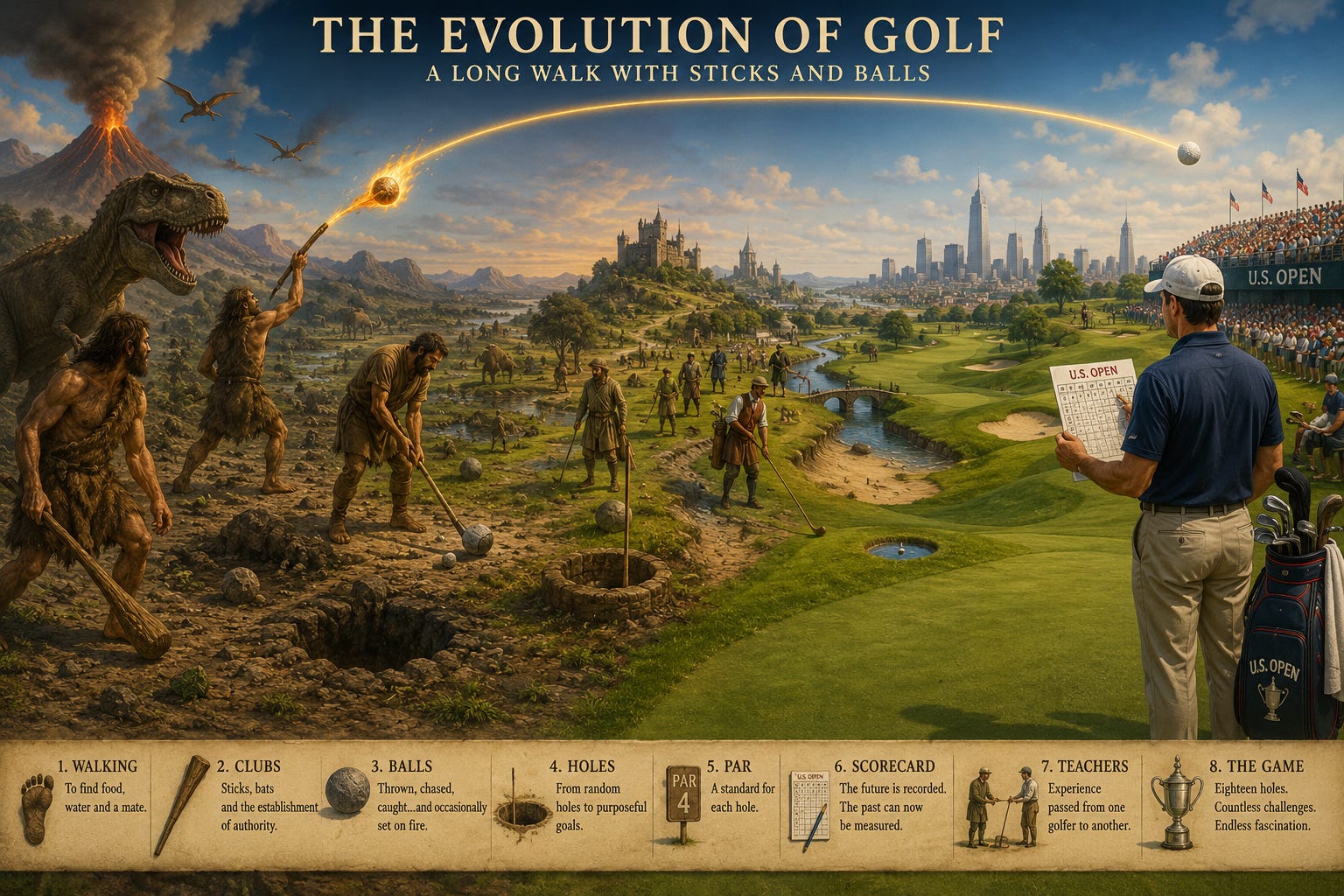
It’s a matter or some dispute as to which came first; the ball or the club.
Let’s start with the club.
The club itself was a great step forward as it modernized the concept of mating and established the order of domestic authority. Much later when whispers, groans, warnings and screams were converted into signals that could describe people, places, things and ideas one of the first “words” was colf or kolf which referred to a club stick or bat. It is certain that golf in its inception did not stand for Gentlemen Only, Ladies Forbidden as the concept of etiquette was lagging in its development so to describe humans at the time of the colf as Ladies or Gentlemen would be a bridge too far if they even had bridges which they didn’t until after hundreds of humans fell screaming into bottomless chasms tryin to figure out how to find some more food.
Next we have the ball.
In a sense, the ball is a miniature laboratory of physics. Every child who throws one is conducting experiments in gravity, momentum, spin, and trajectory without knowing any of those words.
There’s also something almost poetic about it. Humans looked at the world and noticed that many important things are round: the Sun, the Moon, fruits, seeds, eggs, pebbles worn smooth by rivers. Making a ball was one of the first times we deliberately copied nature’s geometry.
So the first ball was likely invented because someone discovered that a round object could be thrown, chased, caught, and shared and that simple discovery turned out to be endlessly entertaining. Long before there were kingdoms, books, or golf courses, and shortly after establishing the concept of fire there were probably children laughing while running after a ball and adults hurling balls at one another and regretfully throwing them at dinosaurs in an early example of hunting/survival that met with very modest success but did speed up the evolution of throwers who we ventually hit uon spears etc which they continued to throw at each other and at the animals that they wanted to eat or the animals that wanted to eat them.
The first fireball arrived when a ball accidentally caught fire and was thrown at a neighbor who would soon become an enemy.
A ball is one of humanity’s first technologies because it teaches important things like throwing accuracy, hand eye coordination, cooperation and competition, predictions that later became known as motion and/or timing.
In just a few paragraphs we’ve covered thousands if not millions if not billions of years and we’re 3/4 of the way to golf. We’ve got walking, we’ve got clubs and we’ve got balls. Yet something important was missing.
I forgot one essential ingredient in what would become known as golf; the concept of trying to find the ball amidst a bunch of hazards like once again dinosaurs, panthers, bears, quicksand, lava and skeletons.
Golf took a gigantic leap forward with the concept of the hole. Up to that point, there were a lot of people with sticks and balls walking around some lovely terrain, doing all sorts of things with their sticks and balls. I’m sure it was all very spontaneous, creative, individualistic, time-consuming, usually comical, but frequently tragic.
Then someone put a hole down in the middle of the field. The beauty of our language assures us that hole rhymes with goal.
The goal of the hole surely cut down on some of the creativity of the walk but it proved to be such a great idea that another hole was dug into the ground, and eventually another, and another, and another, until at around eighteen somebody said, “Okay, that’s enough goals.”
I’m confident that decision was reached after some experimentation with the ideal number of goals. I’m sure many were the proponents for one-hundred-hole golf, maybe even a thousand, particularly on the prairies, where prairie dogs contributed to the facility of architecture.
Too many goals produced a game strikingly similar to no goals at all, with the ensuing fantasy, tragedy, comedy, creativity, profanity, and opposition of will.
After arriving at the more disciplined and focused eighteen holes, some other genius came up with the idea of a par. Par is a standard for each hole. Par is an exemplar representing skillful reaction to the specific problems presented by each well-defined goal.
As each hole developed a standard, someone else came up with the idea of adding all the standards together and coming up with a standard for the entire exercise today known as par for the course which is also a phrase used to describe yet another failure in yet another attempt to find a mate without the benefit of a club.
Shortly after coming up with the standards for each hole, and then the entire course, some other wizard decided to record all of those standards so that each golfer, at the very onset of their walk, had a clear idea not only of the goals of the game, but also of the standards of each goal and each individual course.
Individual holes from different courses could be compared, as could entire courses themselves.
It gradually became accepted that all courses would provide each golfer with this description of the course so that all golfers would be able to measure their skills against the measure of all golfers who preceded them on the course, as well as against golfers who would proceed through it in the future.
It’s not exactly clear when the concept of a “future” first arrived so let’s assume it’s about the time of the discovery of the hole which was used to contain the bodies of some of the folks who discovered that they had no future other then perhaps to be discovered as skeletons becoming visible after centuries of erosion and now revealed as aforementioned hazards.
This series of measures eventually became known as the scorecard.
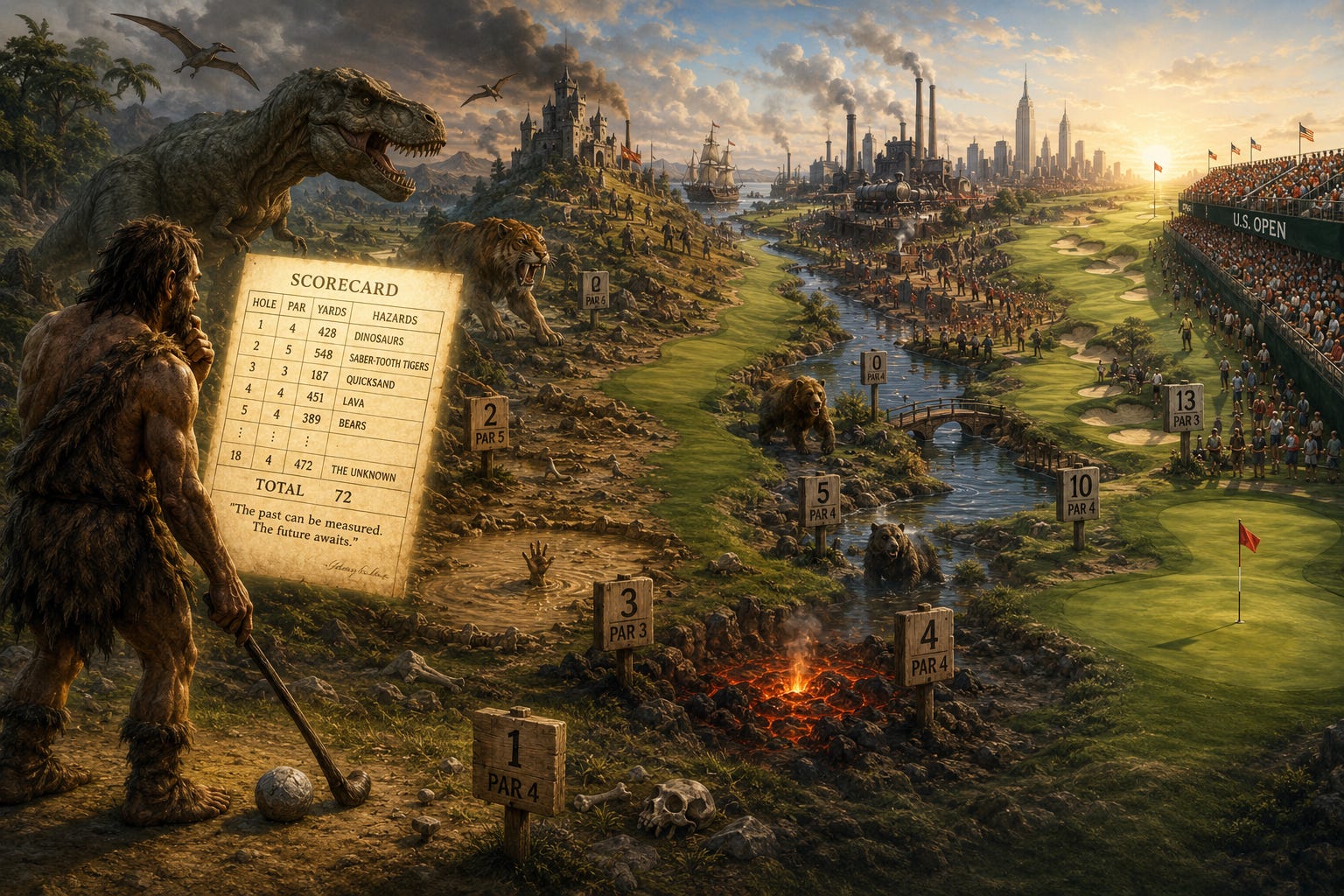
Any golfer worth their putter grew to expect this exact description of the course before they proceeded to embark upon the course itself. Anything else would be primitive and devil-may-care.
With the notion of par, another preconception sort of flew out the window: that of absolute mastery.
Goals were not designed to be reached in one stroke, so the perfect score of eighteen quickly passed into fantasy.
Since the course itself could never be absolutely conquered, golfers instead turned their attention to matching the standards established by the exemplar referred to as “par.”
If a golfer took fewer swings with his stick during his walk through the eighteen holes than his excellent, skillful predecessor who had established par, then that surpassing of standard would have to do as some form of mastery.
With the idea of total mastery subtracted from the equation, golfers began to acclimate themselves to the notion that they were competing against the course itself through comparison of the past performance of others as well as past performances of themselves.
The exemplar called par was always rigorous enough to be almost impossible for the beginner to reach, and did in fact suggest, if not demand, many hours of focused skill-building and repetition.
These hours could be diminished through the help of a teacher. A teacher could sacrifice some of the hours that he or she had spent on the course and transfer the experience gained during those hours to the learner.
Learning golfers gravitated toward teachers who could model exemplary standard attainment.
Even with the help of the best teachers, the ability to reach par, to match or surpass the exemplar, is a tribute to persistence rather than to brilliance.
Since the world is filled with far more persistent people than brilliant people, golf began to grow in popularity.
And so, after millions if not billions of years of evolutionary progress, after the invention of walking, running, clubs, balls, holes, goals, standards, scorecards, teachers and the future itself, we arrive at the modern golfer.
The modern golfer receives a detailed map of the terrain, a precise description of every goal, a numerical standard for every challenge, a cumulative standard for the entire enterprise, and often several conflicting pieces of advice about how best to proceed.
Then he or she places a tiny ball on the ground and attempts to hit it with a stick.
This may not seem like progress, but compared to throwing flaming balls at dinosaurs, it represents a significant advance.
Still, all the important elements remain.
There are hazards.
There is uncertainty.
There is the possibility of triumph, the certainty of disappointment and the persistent hope that the next attempt will somehow be better than the last.
In short, there is golf.
In our next installment we will examine what happens when a reasonably intelligent person carrying a bag full of specialized sticks encounters all of these standards and discovers that understanding them and achieving them are two entirely different things.
.