
Attention Please: Something Wearing Blue and Orange
Has awakened from 50 years of hibernation

Attention and Continuity are complementary temporal engines. One is responsible for what enters consciousness, the other responsible for what survives within it.
Attention governs selection through high-resolution immediacy: it isolates decisive moments, extracts narrative voltage from the present, and generates meaning through impact rather than duration. It moves in discrete instants, each perception complete in itself, allowing rapid responsiveness to shifting events, emotional spikes, and emergent significance
.
In writing, it produces clarity of scene, sharp observational cuts, and the ability to capture the exact pressure of a moment as it happens.
Continuity, by contrast, governs narrative persistence. It binds those isolated instants into a coherent temporal architecture, ensuring that no moment exists without reference to what preceded it or implication for what follows.
It allows earlier developments to remain structurally active within later ones. In writing terms, continuity is what transforms sequence into story: it carries thematic memory, preserves emotional causality, and prevents the narrative from dissolving into a series of disconnected highlights. Where attention illuminates, continuity connects; where attention isolates, continuity integrates.
Applied to the NBA Finals, Attention becomes the courtside intelligence; the ability to seize possession-level drama, a single defensive rotation, a momentum-shifting three-pointer, a facial expression that signals pressure or collapse. It writes in real time, with immediacy and volatility, capturing the lived pulse of each possession as if it were self-contained history. Continuity, however, is what makes the Finals legible as a series rather than a scatter of moments. It tracks series momentum, cumulative fatigue, strategic adaptation, and psychological accumulation across games. It remembers Game 1 inside Game 5, and lets earlier failures or breakthroughs continue to exert pressure on the present contest.
Together, they form a dual-writing mechanism: Attention supplies the incandescent fragments of lived experience, while continuity assembles those fragments into a durable arc of meaning. In isolation, attention risks becoming brilliance without narrative weight, and continuity risks becoming structure without immediacy. But in concert, they are capable of a mode of sports writing that is both visceral and architectural—capable of holding the roar of a single possession and the long echo of a championship series in the same respectful regard.
Part I: Possibility
Every significant story begins in exactly the same place.
Ignorance.
Not ignorance in the pejorative sense. Ignorance in the literal sense. We do not know what is about to happen. We do not know who will matter. We do not know which moments will eventually reveal themselves as turning points. We do not know where significance is hiding.
We only know that something has attracted our attention.
Victor Wembanyama had entered the league carrying the peculiar aura that occasionally surrounds certain athletes. People were not merely discussing his performance. They were discussing his possibilities. The conversation extended beyond what he was and into what he might become.
What interested me was the uncertainty of greatness. The unfolding.
Had someone asked me where this journey would lead, I would have pointed toward Wembanyama. He appeared to be the obvious destination. The towering phenomenon. The future. The gravitational center around which everything else would revolve. Significance possesses a habit of disguising itself. It waits patiently for someone willing to pay attention.
Looking back now, I realize that this project began with an act of faith.
Not faith that Wembanyama would become great.
Faith that attention itself would be rewarded.
Faith that if I remained present long enough, watched closely enough, took enough notes, and accompanied the final playoffs wherever they chose to travel, a story would eventually emerge. I only knew that significant possibility had entered the room.
I had been waiting as it turns out for 50 years.....
Going forward and in recognition of a tendency towards hyperbolic recall/babbling I’m going to shorten this article which means I’m going to start it closer to the finish which is game 5 where we are somewhere midway through the second quarter....
The peculiar thing about possibility is that it eventually acquires details.
At first, a story exists only as a feeling. A hunch. A vague sense that significance may be gathering somewhere beyond the horizon. Then names appear. Games begin. Moments accumulate.The abstract gradually becomes concrete.
The story starts introducing its conclusive self.
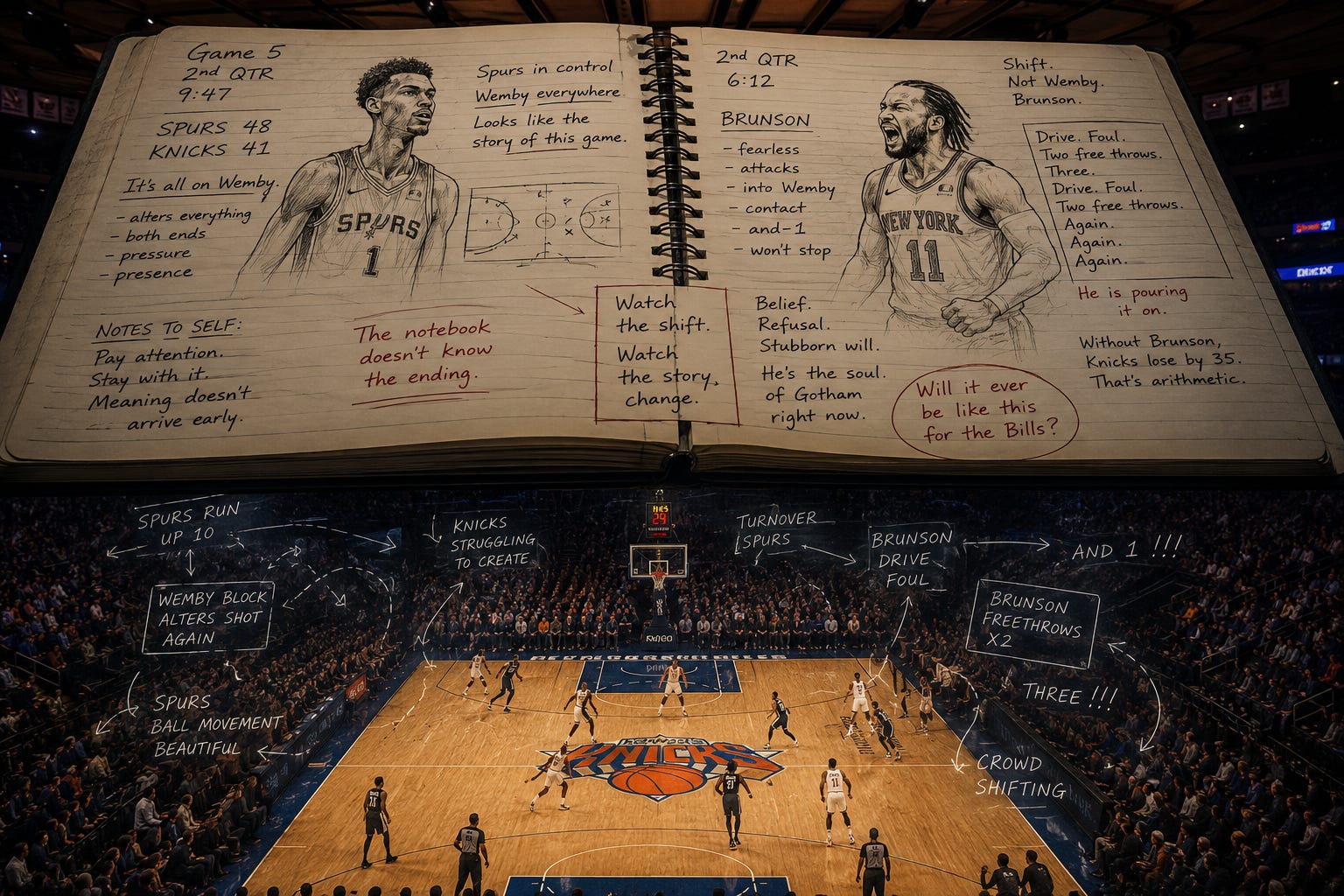
At some point during the game, I wrote three words in my notebook.
“It’s all on Wemby.”
It was an observation. A record of what appeared to be true at that particular moment. The Spurs seemed in control. Wembanyama seemed to occupy the center of every important development. The game appeared to be bending toward him. If San Antonio was going to win, it would be because their extraordinary young star carried them there.
At least that was how it looked from where I was sitting on a couch at Mary’s house. That is one of the reasons I keep notebooks. They preserve first impressions. They preserve uncertainty. They preserve the fragile architecture of a moment before the future arrives and rearranges the furniture.
The notebook does not know the ending. The notebook knows only what is visible now. And in that moment, what was visible was Wembanyama. His reach. His influence. His presence at both ends of the floor.His ability to alter the geometry of basketball itself.
He seemed to be the story of this game or more accurately, he seemed to be the destination toward which the story was moving.
Stories possess a curious habit. They continue to unwind after we think we understand them.
The game continued.
Possessions accumulated.
The pressure increased.
And slowly, almost imperceptibly at first, the meaning of those three notebook words began to change. Not because Wembanyama stopped mattering. Because somebody else began mattering more.
The change was in meaning. The words remained.
At first I did not recognize the shift.
The eye tends to remain loyal to the narrative it expects.
Mine certainly did.
I kept watching Wembanyama.
Meanwhile, another story was gathering force. A different center of gravity was forming.
A different level of inevitability was entering the game.
For a while, I was still watching Wemby.
The game had already moved on.
Part III: Brunson
For a while, I was still watching Wemby but the game had already moved to Brunson.
The transfer of attention occurred possession by possession. Drive by drive. Free throw by free throw.
The Spurs would make a play. Brunson would answer.
The Spurs would build a lead. Brunson would reduce it.
The Spurs would appear ready to seize control. Brunson would refuse permission. He began to score. Great players score. The league is filled with scorers.
What fascinated me was the manner in which he scored.
The fearlessness. again and again he attacked the very place he was supposed to avoid.
Again and again he drove directly toward a defense anchored by Victor Wembanyama.
Most players see Wembanyama standing in the lane and begin calculating alternatives.
Brunson seemed to view him as a destination.
The collisions accumulated. The contact intensified. The game became increasingly physical.
Yet every time Brunson hit the floor, he seemed to rise with even greater determination.
A drive.
A foul.
Two free throws.
A three-pointer.
Another drive.
Another foul.
Another trip to the line.
At some point the statistics ceased feeling like statistics.
They began feeling like evidence.
Evidence that one player had decided his team was not going to lose.
Brunson was pouring it on and I began to wonder...is this what it looks like and feels like to win the title. Will it ever be like this mooemnt for the Bills?
Without Brunson, the Knicks lose this game by thirty-five points.
That isn’t hyperbole.
That’s arithmetic.
He was the offense organizer; the pressure release valve and the emotional center of the team and at this moment the soul of Gotham.
Most importantly, he was the believer.
And belief is a curious force. It is unmeasurably taller than tall stronger than strong faster than time. Every great team eventually becomes dependent upon it.
As the fourth quarter unfolded, I found myself watching something larger than a remarkable basketball performance.
I was watching competitive will.
The refusal to surrender.
The stubborn insistence that a game remains unwon until the final horn sounds.
Brunson was not merely playing basketball.
He was changing the emotional weather of the arena.
And with each possession, the game felt less like a Spurs victory waiting to happen and more like something else entirely.
Something familiar.
Something I had seen before.
Something wearing the colors of New York.
Blue and Orange
The biggest of big sports stories.
With more to come.